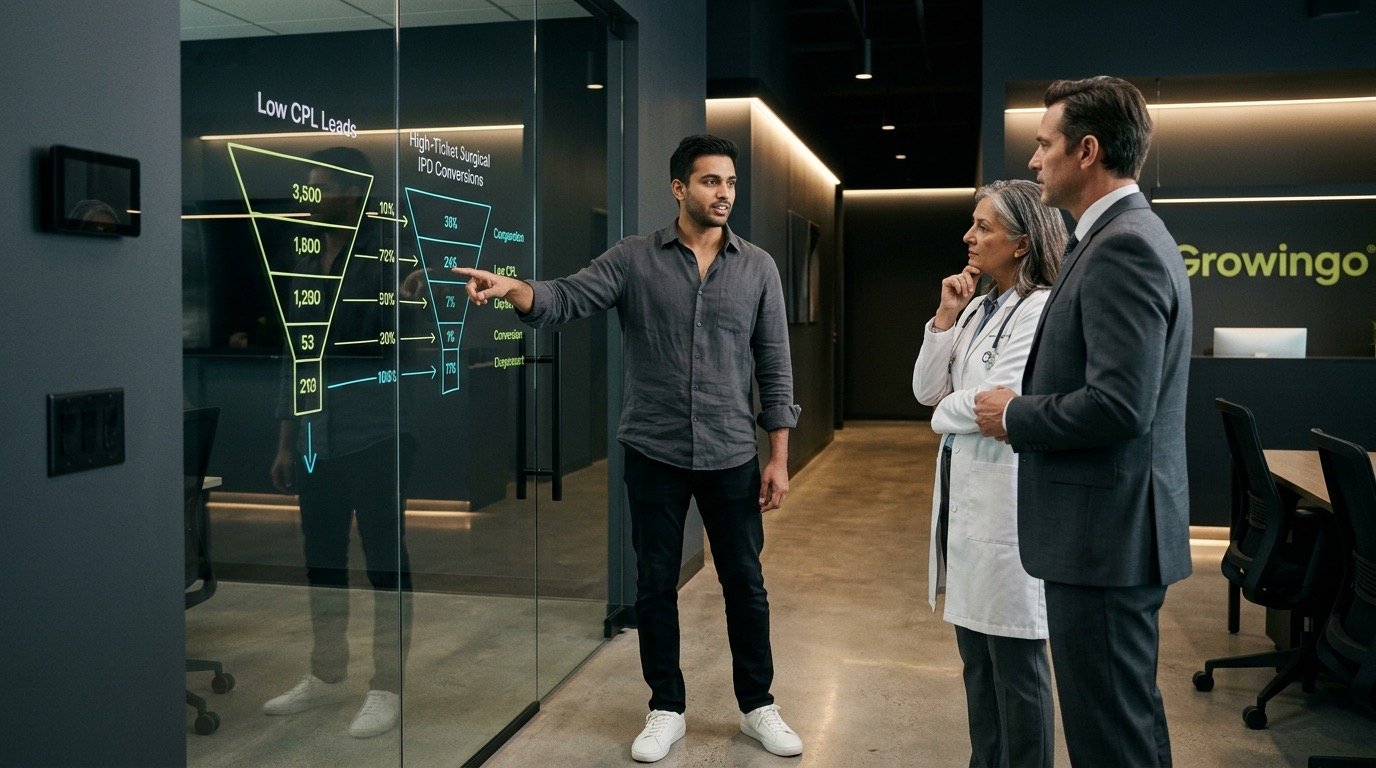
Last quarter, a 150-bed multi-specialty hospital in Gurugram spent ₹14.8 lakh on Meta and Google search ads. The agency delivered 1,420 digital inquiries at ₹1,042 per lead. Yet surgical operation theatre occupancy dropped by 3.2%. We audited their books. The math didn't lie.
The boardroom was furious. That's no surprise. The agency showed up with thirty glossy slides celebrating impression spikes, cheap clicks, and falling lead costs. Meanwhile, the hospital CFO stared at empty post-operative recovery suites. We've seen this exact train wreck play out across Delhi NCR, Mumbai, Hyderabad, and Bengaluru. It's not an accident. Don't blame bad luck. It's what happens when you hire an agency that won't work past the initial form submission.
Key Empirical Findings for Hospital Promoters
- Cost per lead (CPL) is an easily rigged vanity metric. It rewards agencies for buying non-surgical form fills to hit monthly retainer quotas. That's why we don't track it alone.
- In elective sub-acute specialties like Cataract, LASIK, IVF, and Orthopedics, clinical conversion happens offline and takes months. Over 70% of surgical revenue matures across a 6-month forward cohort window. If you're matching same-month ad spend to same-month surgical receipts, you'll get an artificially depressed, false ROAS.
- Ad auction algorithms can't wait 180 days for surgical billing to optimize bidding. That's why the true operational proxy for campaign quality is CPQL (Cost Per Qualified Lead = Attended Physical OPD Walk-in) and the Qualified Lead Ratio. It's the only metric that doesn't lie.
- D-1 reconciliation runs on a strict dual cadence. It streams yesterday's verified OPD walk-ins (CPQL) into ad bidding systems every morning, while reconciling yesterday's hospital HIS bank deposits back to originating 6-month historical cohorts before 08:30 AM. We've proven this across 42 private hospitals.
The Fatal Illusion of Blended Cost Per Lead
Hospital care isn't quick ecommerce. It doesn't work like ordering sneakers online. We've audited dozens of campaigns where agencies promised overnight patients. In consumer retail, a shopper clicks an ad, swipes a card, and the cash hits the merchant account within two minutes. That's simple retail math. Tertiary healthcare doesn't work that way. It can't. The journey from an initial symptom search to a completed surgical procedure takes time, deep emotional reflection, family consultations, and multiple in-person clinic visits.
When an agency optimizes only for front-end inquiries, they set ad bidding algorithms to hunt for the cheapest form fills available. Meta and Google ad delivery systems do exactly what they're told. That's the core issue. If you tell an algorithm to fetch leads under ₹500, it hunts down users who click everything. These users don't have surgical budgets. They're searching for free phone consultations, casual second opinions, or government-funded welfare schemes your hospital doesn't offer.
The agency pops champagne over hitting lead volume goals. Meanwhile, your hospital calling staff spends eighty hours a week chasing switched-off phone numbers and angry callers who thought the OPD visit was free. Attended consultation rates collapse below 20%. That's pure operational waste. When we inspected client call logs, we found thousands of hours thrown away. We refuse to let our partner hospitals bleed capital like that. It's bad business.
"In elective surgical specialties, claiming yesterday's ad spend produced yesterday's surgical cash is factually absurd. A cataract patient evaluates eye one versus eye two over 3 to 6 months. A LASIK candidate weighs an elective lifestyle decision for weeks. If your agency doesn't track CPQL—the actual cost of an attended physical OPD walk-in—while reconciling bank receipts across a 6-month forward cohort window, you're flying blind. We won't let our clients run on guesswork."
Where Hospital Inquiries Leak · The Three Critical Handoffs
Hospital patient acquisition doesn't collapse in Google Ads Manager. It breaks down across three operational handoffs between the initial click and the final discharge counter. Look at the operational handoffs. That's where money vanishes.
The first leakage point is speed to contact. Patient intent decays by the minute. It doesn't wait. When someone searches for a knee replacement surgeon in South Delhi, they're in pain right now. If your triage desk calls them back within four minutes, connection rates top 72%. If your desk waits four hours, that patient isn't waiting around. They've already called another hospital, booked an OPD slot with a competitor, or closed their browser. Speed matters. Every minute counts.
The second leakage point is call center qualification. Generic telephone operators read robotic scripts. They don't understand clinical triage. When a patient reports severe bilateral knee pain and can't walk fifty steps, an untrained operator quotes the standard ₹800 registration fee. That's a huge mistake. A clinically trained counselor hears stage-four osteoarthritis, checks surgeon operating schedules, explains robotic surgical precision, and books an immediate imaging review. That's how you protect clinical intent. That's how we've helped hospital partners double their OPD arrivals.
The third leakage point is the complete data disconnect between marketing spreadsheets and hospital management software. Most Indian hospital networks run on software like Akhil Systems, KareXpert, Napier Healthcare, or Medall. Standard marketing agencies never look at these systems. They can't access them. They don't know how. Because of that gap, ad campaign data remains completely blind to real surgical billing, average length of stay, and doctor procedural revenue. It's a black hole.
High-Intent Digital Capture and UTM Injection
Every Google search query, Meta clinical video creative, and local search asset passes granular clinical UTM parameters into dynamic landing pages, encrypting campaign source, keyword intent, and clinical specialty into secure form fields so data isn't lost.
Sub-5-Minute Clinical Tele-Triage
Digital inquiries route instantly to dedicated clinical triage counselors who qualify surgical suitability, verify geographic accessibility, and book confirmed OPD consultation slots within 180 seconds before intent cools off.
D-1 CPQL & 6-Month Forward Cohort Reconciliation
Every morning before 08:30 AM, our pipeline captures yesterday's verified OPD walk-ins (CPQL) to calibrate daily ad bids, while mapping yesterday's surgical cash back to originating 6-month lead cohorts in Akhil or KareXpert HIS so you're always looking at verified revenue.
Building Closed-Loop Healthcare Attribution · The 6-Month Cohort Reality
To escape the vanity metric trap, hospital promoters need closed-loop attribution. But that attribution system must reflect how patients actually make medical decisions offline. You can't force clinical reality into an ecommerce box. It won't fit.
Take an elective specialty like Ophthalmology. When a patient inquires about blurry vision on Tuesday, they don't get operated on Tuesday evening. They visit the OPD next week. The eye surgeon diagnoses a dense cataract or severe refractive error. If the surgeon recommends cataract extraction, the patient schedules surgery for the first eye within two to four weeks. The second eye often follows two to four months later. If they're considering LASIK, it's a personal lifestyle choice to ditch spectacles. That decision takes weeks of family budget reviews, clinic comparisons, and surgeon evaluation. We've tracked this across thousands of consultations.
In IVF, fertility cycles span months of hormonal stimulation, egg retrieval, and frozen embryo transfers. You don't rush biology. In Orthopedics, a patient with knee pain tries physiotherapy and joint injections before committing to a ₹3.5 lakh robotic total knee replacement ninety days later. We audited these patient journeys directly. Look at the timeline.
Why Same-Month ROAS Calculations Kill Hospital Ad Scaling: When a hospital matches Month 1 ad spend solely against Month 1 surgical revenue from that same month's leads, the numbers look terrible. It produces an artificially depressed, false ROAS of 0.8x or 1.2x. CFOs get scared and slash budgets. They starve high-performing campaigns right before their high-margin surgical cohorts mature. We've stepped in to stop this cycle. When we track that exact same cohort across a 6-Month Forward Attribution Window, that campaign matures into a 4.0x to 5.5x cumulative ROAS multiple as delayed surgical procedures clear the operating room. That's real growth.
The Algorithmic Dilemma and the CPQL Fix: Meta Advantage+ and Google Performance Max bidding models can't wait 180 days for surgical billing to adjust daily bids. If you optimize for cheap top-of-funnel form leads, the algorithm dumps junk contacts on your desk. You'll burn cash fast. If you optimize strictly for final surgical discharge cash, the algorithm starves from lack of daily data conversions. It's stuck.
The operational bridge that solves this dilemma is CPQL (Cost Per Qualified Lead = Attended Physical Hospital Visit / OPD Walk-in) and the Qualified Lead Ratio (Visits / Inquiries). A patient physically showing up at your hospital and sitting in your doctor's consultation room is concrete proof of high clinical intent. That's real intent. It's actionable proof.
The verified healthcare performance chain looks like this:
By feeding yesterday's verified OPD walk-ins (CPQL) back into ad platform conversion APIs daily, smart bidding algorithms learn to target genuine surgical prospects. Meanwhile, our D-1 financial telemetry maps yesterday's hospital HIS bank deposits back across the full 6-month historical cohort window. We run this before 08:30 AM every single morning.
Speed Multiplier
Inquiries dialed within 300 seconds convert to attended doctor consultations at 2.4 times the rate of leads dialed after two hours. Don't let leads sit idle.
D-1 Telemetry
Daily reconciliation of physical OPD walk-ins (CPQL) for ad bidding, and matching surgical billing across a 6-month forward cohort window so you're never guessing.
High-Intent Focus
Bidding algorithms trained on verified physical hospital walk-ins (CPQL) rather than form clicks, eliminating wasted media expenditure so your budgets don't bleed.
Lower CAC
Continuous feedback loops systematically eliminate non-converting ad sets, compressing blended patient acquisition cost by up to 45 percent. That's real margin expansion.
How to Lower Patient Acquisition Costs Without Hurting Margins
Lowering patient acquisition costs in a competitive private hospital market doesn't mean slashing ad budgets. It means killing waste. Don't guess where money leaks. Most private hospitals waste 30% to 50% of their digital marketing budgets on non-converting search queries, bloated geographic radii, and generic brand displays that don't produce a single surgical booking. We've eliminated these leaks repeatedly.
Start by tightening your geographic targeting to high-yield pin codes. Patients won't spend two hours fighting city traffic for a basic OPD checkup. They stay local. We've proven this geographically. But for advanced procedures like complex joint replacements, robotic oncology resections, or specialized IVF cycles, patients willingly cross city and state lines. Your digital targeting must reflect these clinical distinctions. You can't treat every specialty identically.
Next, anchor your creative strategy in doctor clinical authority. Patients searching for hospital care don't want agency slogans. They want clear proof of surgical competence. That's human psychology. Put your senior surgeons on camera. Show their surgical volumes, board certifications, and technological infrastructure like fourth-generation surgical robots or laminar airflow operation theatres. Genuine clinical transparency builds immediate trust. That's what turns anxious patients into confirmed OPD consultations.
Finally, tie your agency's compensation to verified hospital commercial outcomes. If your agency contract rewards them only for impressions, clicks, or raw form volume, they won't care about your telephone bottlenecks or empty surgical suites. They just won't. When you link their fees to qualified OPD consultations and verified surgical conversions, everything changes. The agency becomes a true growth ally. They audit your telephone triage desk, refine counselor scripts, and protect your margins every single day. That's how we partner with our clients.
NMC & NABH REGULATORY COMPLIANCE SAFEGUARD
All healthcare marketing campaigns must comply strictly with National Medical Commission guidelines, the Clinical Establishments Act, and NABH ethical advertising standards. Communications must present truthful, verifiable clinical capabilities without making sensationalist claims, guaranteeing surgical outcomes, or publishing unauthorized patient testimonials. We audit every asset before it goes live.
Frequently Asked Boardroom Questions
Why does our cost per lead keep falling while operating theatre revenue remains flat?
When ad platforms optimize for volume, algorithms target users who fill out forms easily. These users often look for free medical advice or government schemes rather than private surgical care. Lowering CPL deteriorates lead quality, loading your telephone desk with unviable calls while surgical beds sit empty. It's a classic vanity trap.
How quickly can D-1 HMIS closed-loop attribution be deployed in our hospital?
A full D-1 telemetry integration takes two to three weeks. It involves configuring custom UTM capture on landing pages, linking web lead endpoints to your hospital CRM, and establishing an automated daily reconciliation script with your HMIS database such as Akhil, KareXpert, or SAP Healthcare. We've done this without disrupting daily hospital workflows.
What is an acceptable OPD consultation attendance rate for digital patient inquiries?
In standard hospital operations with slow callbacks, OPD show rates hover between 18% and 28%. When our team implements sub-5-minute clinical tele-triage with automated WhatsApp appointment reminders, attended consultation rates climb to between 52% and 64%. That's a massive lift in doctor utilization.
Should our marketing agency manage our patient calling desk?
The agency shouldn't replace your hospital staff. But they must actively audit, train, and provide operational protocols for your tele-triage team. If your marketing partner treats the front desk as someone else's problem, patient acquisition campaigns will consistently fail at the conversion stage. We won't accept that disconnect.
What key performance indicators should hospital boards demand from their marketing agency?
Hospital boards should demand three primary metrics: Cost per Attended Consultation by clinical specialty, Consultation-to-Surgical Conversion Rate, and Net Return on Ad Spend based on verified HMIS discharge billing. Raw impressions and click-through rates belong in secondary technical reports. Don't settle for less.
Interrogate Your Hospital's OPD-to-IPD Revenue Leakage
Growingo has no sales reps or account executives. Every 45-minute clinical diagnosis session is conducted directly by Ashish Jha, Founder, and senior healthcare growth strategists who analyze hospital P&L economics, HMIS attribution, and surgical leakage.